The Daily Mail On Alexander Fiske-Harrison & Camille Natta with David Yarrow’s Book On Wolves

Alexander Fiske-Harrison & Camille Natta


DAILY MAIL
22 November 2025
The smart set’s talking about… Daredevil relights old flame after parting from polo star
Once hailed as ‘the most bad-ass Old Etonian ever’, daredevil author Alexander Fiske-Harrison has taken fright at matrimony.
I hear that the [Belgravia]-born former bullfighter, 49, has ended his engagement to top Austrian polo player Klarina Pichler, 44, and rekindled a romance that began in the quads of Oxford University.
‘I can confirm that Klarina and I parted ways at the beginning of this year, with great sadness and mutual respect,’ Xander tells me. ‘I have finally washed the blood [of bullfighting] from my hands and pivoted back to my original role [as conservation biologist], from my time at Oxford.’
He is now going out with a girlfriend from his university days, the French film actress Camille Natta, 48.
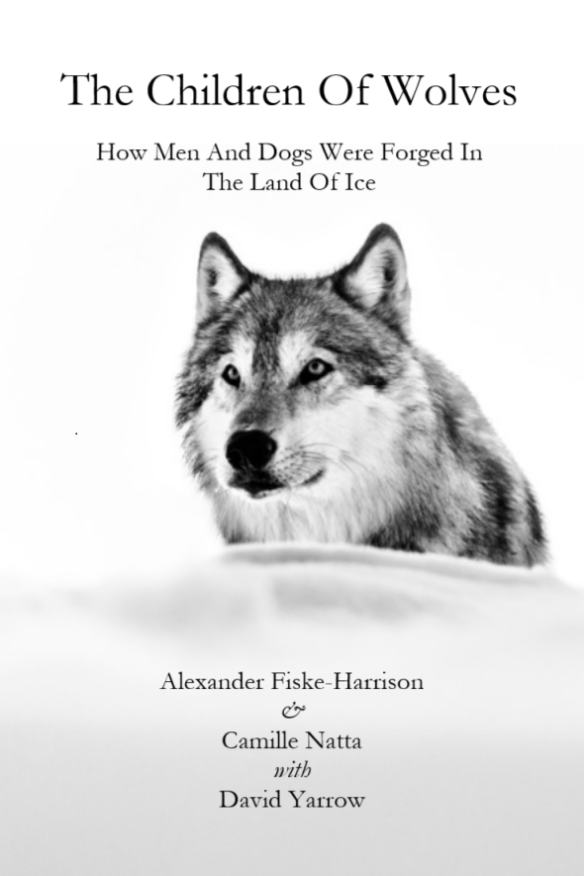
‘Next week, we set off, reunited like Odysseus and Penelope,’ says Xander, who’s writing a book with Camille [as photographer, The Children Of Wolves: How Dogs and Humans Were Forged In The Land Of Ice, alongside the great David Yarrow.]
He previously went out with Lord Brocket’s model daughter, Antalya Nall-Cain, [11] years his junior [and until recently Princess of Prussia.]

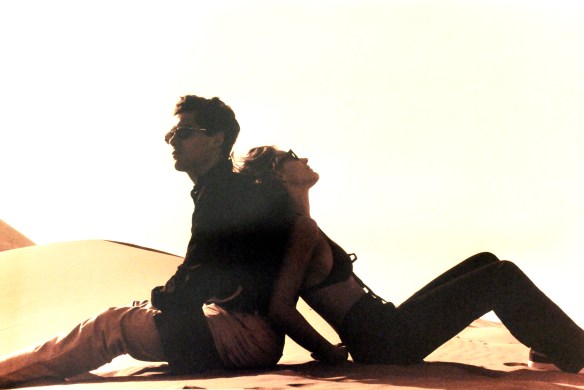
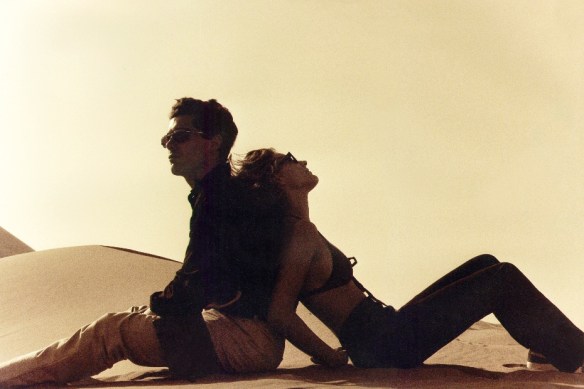
Author’s Note: The Daily Mail may have exagerated somewhat – Camille remains married to her husband and has subsequently left the book project, although she was very dear to me, as the photo below from our time in the Sahara Desert after I graduated from the University of Oxford, and she entered her final year, shows. Alexander Fiske-Harrison


Alexander Fiske-Harrison & Camille Natta in the Sahara Desert in 1998 (Photo: Camille Natta [self-timer])

NEW YORK MAGAZINE: VULTURE – “I excuse myself to use the restroom. When I return, Winters is deep in conversation with the man sitting next to us: a British writer named Alexander Fiske-Harrison, who is working on a book about wolves. On the walk up, we had started talking about relationships. There were a couple of times that Winters had come close to settling down, but it had never happened. It was no one’s fault, he said. He supposed it was never too late to have children, but he didn’t really want to be a 70-year-old dude with a little kid.
Now, a fuller story emerges. One of Winters’s exes had remained in his life, but they’d had a falling-out. He despaired of ever seeing her again. Outside the bar, Alexander presses him: “Did you do the full back-down? There are two ways to apologize. One way is, ‘I’m really sorry if what I did offended you.’ And the other way is, ‘I’m very sorry.’” Among the men around him, opinions vary on what Winters should do. Alexander shares his own tale of romantic turmoil [see above]. Then for the next 15 minutes or so, Winters and I go silent as he entertains us with accounts of interviewing bullfighters in Spain.”
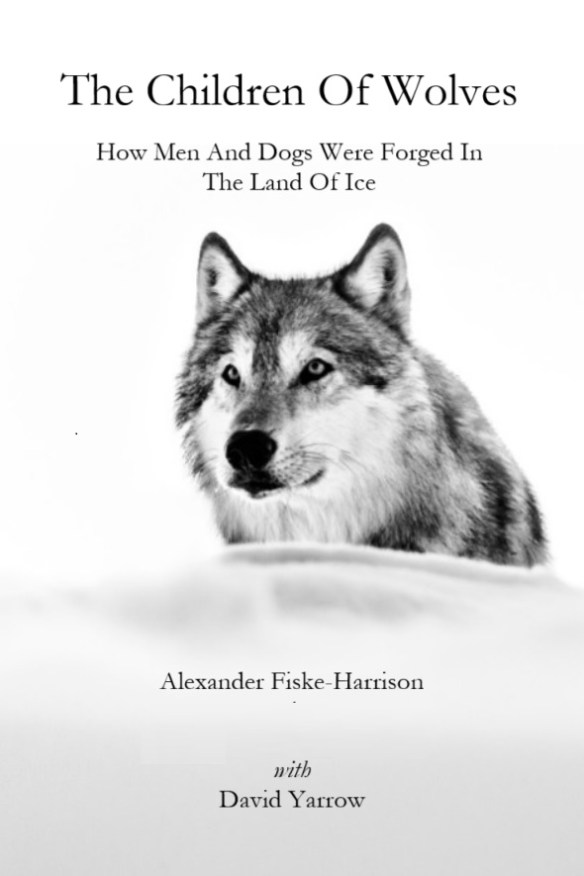
The cover as originally mocked up

“Britain’s leading bullfighter” in The Times

THE TIMES

JULY 13 2024

DIARY

PATRICK KIDD

A LESSON IN COLD BLOOD

Alexander Fiske-Harrison, Britain’s leading bullfighter, is inspired by men who keep their upper lip starched. He writes in Boisdale Life that his hero is Charles Upham, twice winner of the Victoria Cross. In 1943, Upham attempted a bold daylight escape from a prisoner of war camp only to get caught on the barbed wire. A Nazi corporal put a loaded pistol to his head but Upham reminded him that it was only legal to shoot a PoW while escaping. Since he clearly could not move, he should be spared. He then lit a cigarette and said: “And I refuse to be shot by a bloody corporal. Bring an officer.” Upham lived for another 51 years.”

Boisdale Life Editor’s Lunch & Awards 2024 Davidoff Bon Viveur Of The Year: Alexander Fiske-Harrison

Natasha Hamilton, formerly of the band Atomic Kitten and, far right, William Sitwell, restaurant critic for The Daily Telegraph, host as Roy Sommer, Managing Director of Davidoff cigars presents the ‘Davidoff Bon Viveur of The Year Award’ to Alexander Fiske-Harrison, for his article ‘Courage Best’. On the left is AFH’s old friend, whom he had not seen since 1991 and who recently left the British Army after 23 years, including two decades in the 22 SAS, and with whom AFH is now working on new project, more which later (Photo: Jules Annan)

Click on image for PDF

COURAGE BEST

Alexander Fiske-Harrison

Britain’s only bullfighter and veteran bull runner, pays homage to British stoicism and bravery

THE most laconic tale of British bravery in combat is arguably Lord Uxbridge’s sang froid remark after being struck by cannon shot at the Battle of Waterloo: “My God, Sir, I’ve lost my leg.”

To which the Duke of Wellington replied:

“Yes, Sir, so you have.”

One doesn’t need to be a Kenneth Tynan to recognise this as a performance, even if made unconsciously, with understatement used to say infinitely more than the words themselves. It does not make much difference if the story is apocryphal: the mere fact that the story has survived in popular consciousness in this form tells us exactly what the British perceive their own particular brand of bravery to be.

It is also hardly surprising, then, that I grew up with the Charge of the Light Brigade as my model, as it was to the British Army. Indeed, it is from the cannon captured that day that most of the Victoria Cross medals are cast (more of the VC later).

Compare this form of courage with a tale from my adopted country of Spain. In 1936, during the Spanish Civil War, the medieval Alcázar fortress of Toledo was under siege to little effect, when the attackers captured the son of the colonel of the garrison. They reconnected the severed telephone lines and summoned the colonel to the parapets so he could watch as his son was handed the telephone to tell him that he would be executed unless the fortification surrendered. The colonel told his son that ‘he knew what to do’. Father and son saluted one another, the son turned and told his captor to shoot him, which he duly did, before he turned to salute the father, who returned the salute.

The tales of Uxbridge and the Spanish colonel are extreme examples of courage. But like a cocktail mixed with alien versions of similar ingredients, the latter’s is somehow un-British. Nevertheless, we recognise the resemblance.

Seneca, the father of Roman Stoicism, was a Spaniard born in Córdoba, hence the Hispanic flair in his pronouncements on this subject. “A man who has learned how to die has unlearned how to be a slave,” he wrote. It was no idle theorising, for within twelve months the Emperor, his former pupil, falsely accused him of conspiracy. Seneca duly took his own life, remarking, with more than a hint of caustic Britishness: “After murdering his mother and brother, it only remained for Nero to kill his teacher and tutor.”

One of the reasons I came to Spain was to witness an echo of such bravery outside of war. Ernest Hemingway gave a similar reason for coming to watch bullfights one hundred years ago. I remember when I first went to Pamplona to run with the bulls, I witnessed the boiling mass of 300 tonnes of humanity fleeing four tonnes of toros bravos, Spanish fighting bulls. The mass of people shattered and fled like a medieval rabble under a heavy cavalry charge. This was a sight few people in the modern era will ever see: a populace put to flight through its own streets, as though a siege had been broken, a city wall breached. Of course, I am aware that the event itself, and even talking about having done it, is all rather un-British.

Alexander Fiske-Harrison runs between two bulls in Pamplona in 2011

Continue reading

Wolves & Warriors: The Journey Begins….

Chapter one of my forthcoming book on wolves, dogs and humans is in the bag with my favourite collaborator, and oldest and most talented friend, Camille. As reported on in New York Magazine (online here.)

Wolves and Warriors at LARC
The Howling Press from the Lockwood Animal Rescue Center and the Wolves and Warriors® Program

(LARC’s Twiggy overlooking our local Los Padres Mountains)

Echoes In The Ice: How Dogs And Men Emerged From The Land Of Wolves

The book has a central thesis that the domestication of wolves into dogs was not merely a human achievement but a mutually transformative evolutionary event, where wolves played an integral part in not only shaping human pre-history, but in allowing it to exist in the first place. They were vital to our very survival during the last Ice Age – going on to help craft the shape of both human society and the human mind. This will be explored through the multiple lenses of science and myth, psychology and literature, and most of all from travels to visit wolves around the world.

Writer: Alexander Fiske-Harrison is an author and journalist (e.g., in The Times of London, Condé Nast’s GQ, BBC, CNN, and more). He began studying biology and then philosophy at Oxford and went on to study foundations and history of science and applied neuroscience at London..

Location Photographer: Camille Natta, actress-director and professional photographer, studied philosophy at Oxford where her and Alexander met. She was the lead in Crimson Rivers, directed Julia, and was in the show The Black List. Her photography has been exhibited in Europe and appeared in the French newspaper Le Monde.

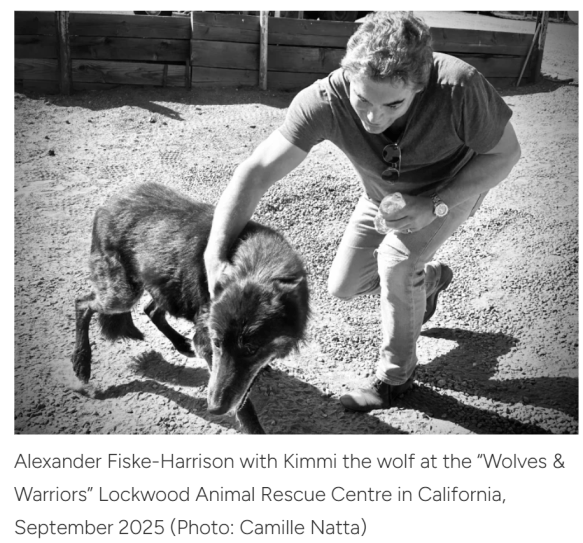
Alexander Fiske-Harrison with a rescued wolf, northern California, 12 September 2025 (Photo: Camille Natta)

Art Photographer: David Yarrow is the world’s most famous fine-art photographer.

(Images of Alexander, Camille, wolves, and LARC grounds)

LARC was thrilled to be interviewed by author and journalist Alexander Fiske-Harrison and Camille Natta, photographer and actress-director

Camille Natta, actor-director-photographer

Alexander Fiske-Harrison (Photo: Andrea Savini/¡Hola! magazine)

New York Magazine on Alexander Fiske-Harrison’s Book On Wolves

Dean Winters with Michael Nyqvist in John Wick

Camille Natta, actor-director and photographer

I crashed the New York magazine interview of a favourite actor of mine, Dean Winters, whom I remember so well as the chief villain’s consigliere, Avi. (Along with a thousand other credits, including from Law & Order whose set I had just been on as I was staying with my dearest friend from university, Hugh Dancy, who leads the current series, and his wonderful wife Claire Danes in Manhattan.)

Dean, and the journalist Nate Jones, came to the oldest bar in the city, The Ear at 326 Spring Street, near the Hudson (actually, where the Hudson river used lap against the front door), just after my meeting with my collaborator and sometime partner, the actor-director and photographer Camille Natta. (Another collaborator of mine is the greatest fine art photographer of animals alive today, David Yarrow.)

Alexander Fiske-Harrison & Camille Natta in the Sahara Desert after graduating from the University of Oxford (Photo: Camille Natta [timer])

NEW YORK MAGAZINE: VULTURE – I excuse myself to use the restroom. When I return, Winters is deep in conversation with the man sitting next to us: a British writer named Alexander Fiske-Harrison, who is working on a book about wolves. On the walk up, we had started talking about relationships. There were a couple of times that Winters had come close to settling down, but it had never happened. It was no one’s fault, he said. He supposed it was never too late to have children, but he didn’t really want to be a 70-year-old dude with a little kid.
Now, a fuller story emerges. One of Winters’s exes had remained in his life, but they’d had a falling-out. He despaired of ever seeing her again. Outside the bar, Alexander presses him: “Did you do the full back-down? There are two ways to apologize. One way is, ‘I’m really sorry if what I did offended you.’ And the other way is, ‘I’m very sorry.’” Among the men around him, opinions vary on what Winters should do. Alexander shares his own tale of romantic turmoil. Then for the next 15 minutes or so, Winters and I go silent as he entertains us with accounts of interviewing bullfighters in Spain.


nversation with the man sitting next to us: a British writer named Alexander Fiske-Harrison, who is working on a book about wolves. On the walk up, we had started talking about relationships. There were a couple of times that Winters had come close to settling down, but it had never happened. It was no one’s fault, he said. He supposed it was never too late to have children, but he didn’t really want to be a 70-year-old dude with a little kid.
Now, a fuller story emerges. One of Winters’s exes had remained in his life, but they’d had a falling-out. He despaired of ever seeing her again. Outside the bar, Alexander presses him: “Did you do the full back-down? There are two ways to apologize. One way is, ‘I’m really sorry if what I did offended you.’ And the other way is, ‘I’m very sorry.’” Among the men around him, opinions vary on what Winters should do. Alexander shares his own tale of romantic turmoil. Then for the next 15 minutes or so, Winters and I go silent as he entertains us with accounts of interviewing bullfighters in Spain.”

Requiescat In Pace Kela – 24 December 2009 – 9 September 2024

Kela 2022

(Auf Deutsch darunter.)

FRIEND

“There lay the dog Argos.
Then, when he noticed Odysseus near,
he wagged his tail and both his ears drooped,
but he could no longer move towards his master
to approach him; however, seeing him from afar, he wiped away a tear…
And then death took Argos as his fate,
immediately after seeing Odysseus in the twentieth year.”
Homer, The Odyssey, Book 17


Like a perfect pebble,
found upon a beach strewn with one thousand rough-edged stones—
this one, polished by nothing but coincidence,
feeling smooth only to your touch.

A comfort,
a concern,
a greeting and goodbye—
a weapon sometimes,
loyal against the world,
against everything not her own.

But for her own she stood
more sure,
more solid,
than Mother Earth herself.

Which is why you held that stone in your hand,
forgetting, for as long as you could,
its unbearable weight,
until your arms ached.

Until that day,
you had to walk out into the sea,
grasping her tight,
delaying the letting go—
fending off the horror,
fending off the betrayal,
fending off
the forgetfulness of human grief.

Alexander Fiske-Harrison

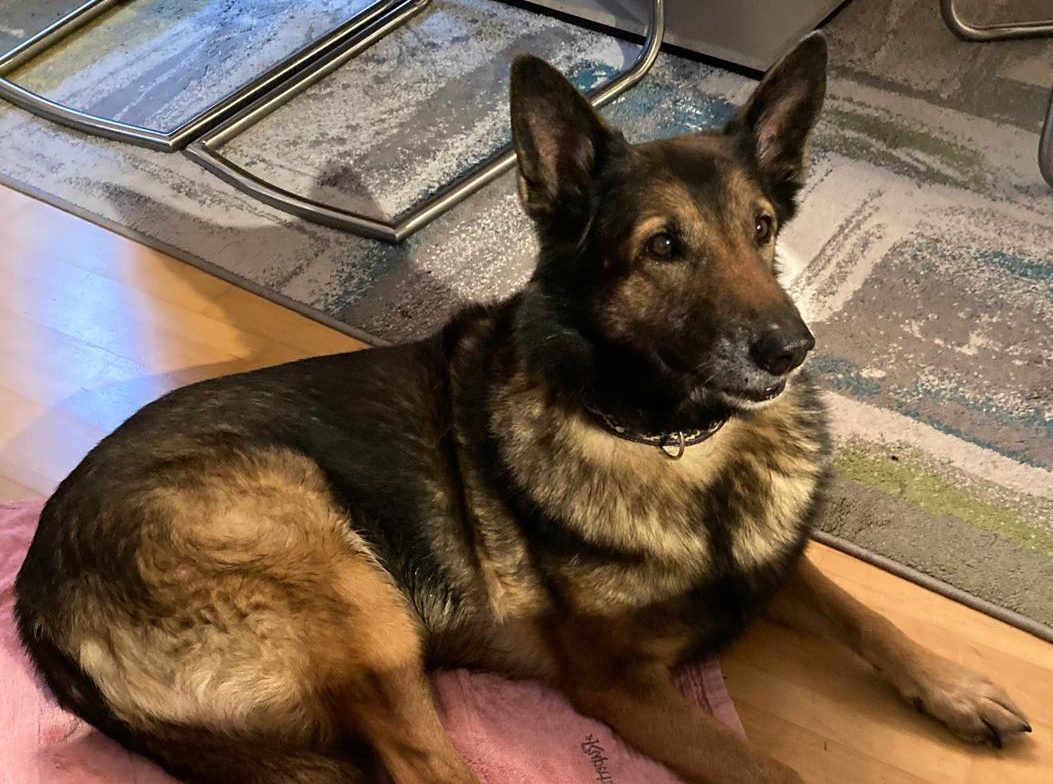
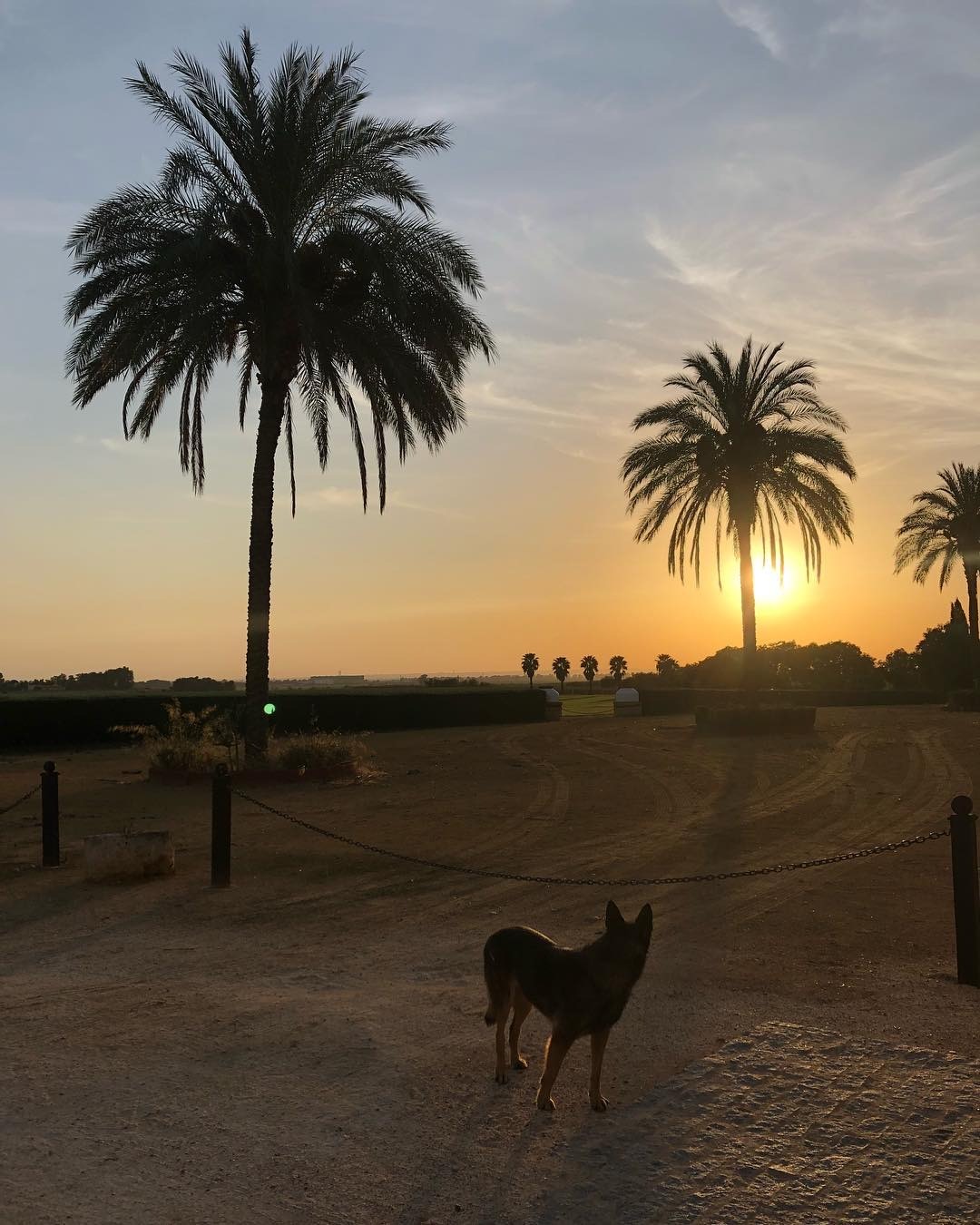
Kela, a Belgian-German Shepherd cross, was born in the Alps of Salzburgerland in Austria on Christmas Eve in 2009,  and died in the arms of her mistress, my fiancée, Klarina Pichler, almost fifteen years later, on the day of San Pedro Claver y Corberó, patron saint of slaves, and those who travel by sea which she did so much, in the hills of Sotogrande in Andalusia looking out onto the Mediterranean Sea. 

As a puppy, she, out of the entire litter, chose her mistress herself – a pebble among rough stones, smooth only to her touch .

At the end, her lithe mass of muscle once giving such speed and strength was diminished to nothing but an almost unmoving happiness at our company and her mistress and I alternated carrying her wherever she needed to go.

Even then, we did not want to let go, did not want to let the veterinarian in to our house beside the sea, betraying the definition of loyalty itself, an act of kindness that felt so great a sin it would make Judas himself turn red with shame.

(She was the most notable dogs I have ever met, famous among those who knew her and even among those who did not, making national newspapers like The Daily Telegraph, online here.)

Kela 2018

SEELENSCHATZ

“Dort lag der Hund Argos.
Als er Odysseus nahe bemerkte,
wedelte er mit seinem Schwanz und ließ beide Ohren hängen,
aber er konnte nicht mehr zu seinem Herrn gelangen,
um sich ihm zu nähern; dennoch, ihn aus der Ferne sehend, wischte er eine Träne weg…
Und dann nahm der dunkle Tod Argos als sein Schicksal,
gleich nachdem er Odysseus im zwanzigsten Jahr gesehen hatte.”
Homer, Die Odyssee, Buch 17

Wie ein perfekter Kiesel,
gefunden an einem Strand, übersät mit tausend rauen Steinen—
dieser eine, zufällig geschliffen,
fühlt sich nur unter deiner Berührung glatt an.

Ein Trost,
eine Sorge,
ein Gruß und Abschied—
manchmal eine Waffe,
treu gegen die Welt,
gegen alles, was nicht ihr eigen ist.

Aber für die Ihren stand sie
fester,
solider,
als Mutter Erde selbst.

Deshalb hieltest du diesen Stein,
vergessend, so lange du konntest,
sein unerträgliches Gewicht,
bis deine Arme schmerzten.

Bis zu dem Tag,
an dem du ins Meer hinausschrittest,
sie fest umklammernd,
zögertest du das Loslassen hinaus—
wehrtest das Entsetzen ab,
wehrtest den Verrat ab,
wehrtest die Vergesslichkeit menschlichen Leids ab.

Alexander Fiske-Harrison

Kela, eine belgisch-deutsche Schäferhund-Mischung, wurde am Heiligen Abend 2009 in den Alpen des Salzburger Landes in Österreich geboren und starb fast fünfzehn Jahre später in den Armen ihrer Herrin, Klarina Pichler, am Tag des San Pedro Claver y Corberó, dem Schutzpatron der Sklaven und derer, die auf See reisen, was sie so oft tat, in den Hügeln von Sotogrande in Andalusien mit Blick auf das Mittelmeer.

Als Welpe wählte sie, aus dem ganzen Wurf, ihre Herrin selbst aus – ein Kieselstein unter rauen Steinen, glatt nur zu ihrer Berührung.

Am Ende war ihre schlanke Muskelmasse, die ihr einst so viel Schnelligkeit und Stärke verlieh, zu nichts weiter als einer fast unbeweglichen Freude an unserer Gesellschaft verkommen, und ihre Herrin und ich wechselten uns ab, sie überallhin zu tragen, wo sie hin musste.

Selbst dann wollten wir nicht loslassen, wollten den Tierarzt nicht in unser Haus am Meer lassen, was das Wesen der Treue selbst verriet, eine Tat der Güte, die sich so sehr nach Sünde anfühlte, dass sie sogar Judas selbst zum Erröten gebracht hätte.

(Sie war der bemerkenswerteste Hund, den ich je getroffen habe, berühmt unter denen, die sie kannten, und sogar unter denen, die sie nicht kannten, und schaffte es in nationale Zeitungen wie The Daily Telegraph, online hier).

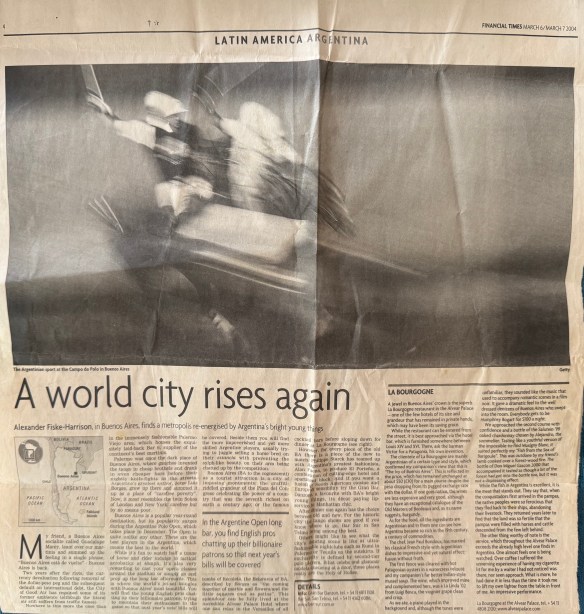
FINANCIAL TIMES: My article on Buenos Aires – ‘A world city rises again.’

FINANCIAL TIMES

FT Weekend

March 6/March 7 2004

LATIN AMERICA: ARGENTINA

[Photo Caption: The Argentinian sport at the Campo de Polo de Buenos Aires – Getty]

A world city rises again

Alexander Fiske-Harrison, in Buenos Aires, finds a metropolis re-energised by Argentina’s bright young things

My friend, a Buenos Aires socialite called Guadalupe Marey, leant over our martinis and summed up the feeling in a single phrase, “Buenos Aires está de vuelta” — Buenos Aires is back.

Two years after the riots, the currency devaluation following removal of the dollar-peso peg and the subsequent default on international debt, the City of Good Air has regained some of its former ambience (although the literal air still suffers from traffic fumes).

Nowhere is this more the case than in the immensely fashionable Palermo Viejo area, which houses the exquisitely laid-back Bar 6, supplier of the continent’s best martinis.

Palermo was once the dark place of Buenos Aires, where gauchos invented the tango in cheap brothels and drank in even cheaper bars before their nightly knife-fights in the streets. Argentina’s greatest author, Jorge Luis Borges, grew up there and summed it up as a place of “carefree poverty”. Now, it most resembles the twin Sohos of London and New York: carefree but by no means poor.

Buenos Aires is a popular year-round destination, but its popularity surges during the Argentine Polo Open, which takes place in December. The Open is quite unlike any other. These are the best players in the Argentina, which means the best in the world.

While it’s fun to watch half a tonne of horse and rider indulge in tactical acrobatics at 30mph, it’s also very rewarding to cast your opera classes around the stadium or simply go and prop up the long bar afterwards. This is where the world’s jet-set mingles with Buenos Aires’ most beautiful. You will find the young English pros chatting up their billionaire patrons, trying to maintain their enthusiasm in the game so that next year’s vets’ bills will be covered. Beside them you will find the more impoverished and yet more skilled Argentine players, usually trying to juggle selling a horse bred on their estancia with preventing the sylph-like beauty on their arm being chatted up by the competition.

Buenos Aires (BA to the cognoscenti) as a tourist attraction is a city of imposing monuments: the graffiti-riddled grandeur of the Plaza del Congreso celebrating the power of a country that was the seventh richest on earth a century ago; or the famous tombs of Recoleta, the Belgravia of BA, described by Borges as “the coming together of marble and flowers/and the little squares cool as patios”. This splendour can be fully lived at the incredible Alvear Palace Hotel where one can relax in the Versailles of all cocktail bars before sloping down for dinner at La Bourgogne (see right).

However, for every piece of the old BA there is a piece of the new to match. Philippe Starck has teamed up with Argentina’s greatest fashionista, Alan Faena, to produce El Porteño, a combination of cutting-edge hotel and apartment block. And if you want a fusion of South American cuisine and European sensibility try the Gran Bar Danzon, a favourite with BA’s bright young things, its décor paying lip-service to Manhattan chic.

After dinner one again has the choice between old and new. For the historic city the tango shows are good if you know where to go, Bar Sur in San Telmo being among the best.

Others might like to see what the city’s dancing scene is like at ultra-fashionable nightclubs such as Rumi in Palermo or Tequila on the outskirts. If exclusivity is defined by second-tier polo players, B-list celebs and glamour models queueing at a door, these places really are the Holy of Holies.

DETAILS
Info: Gran Bar Danzon, tel. +54 11 4811 1108
Bar Sur, San Telmo, tel. +54 11 4362 6086;
http://www.bar-sur.com.ar

LA BOURGOGNE

A jewel in Buenos Aires’ crown is the superb La Bourgogne restaurant in the Alvear Palace – one of the few hotels of its size and grandeur that has remained in private hands, which may have been its saving grace. Continue reading

The Untouchable – My Short Story Finalist for Le Prix Hemingway International 2022


(Originally published in French by Au Diable Vuavert, translated from the original English enclosed below. En español aquí. )

THE UNTOUCHABLE

by Alexander Fiske-Harrison

For Camile Natta

I was told this story by an elderly Englishman who boarded the ‘Ciudad de Sevilla’ alongside me at the Port of Marseilles, en route to Rio de Janeiro in the Spring of 1940. His French was rusty and this had led to some confusion with the marseillais-speaking porters, so I assisted him and he thanked me in my own native Castillian, even though we had conversed in English up until that moment.

Seeing him dining alone that evening, I accepted his invitation to join his table. The rest of the ship’s passengers were refugees from Europe’s troubles, and that difference in itself gave us something in common.

He was clearly a man of private means and was journeying to Petrópolis to pay his respects at the funeral of the son of the old Emperor, whom he had known as a young man. I told him that I worked as a translator and had been sent by a publishing house to assist one of their authors, an Austrian, who had fled due to his religion and race and was seeking safe haven in Latin America.

We bonded over a shared love of history and storytelling and, as the wine flowed, he gained confidence and began to switch readily between my language and his, and I remarked that he must have spent some time in Spain.

This remark, innocently made, gave him pause, and I wondered if I had offended him or opened some old wound, and I apologised. He brushed my words aside and, having made some internal decision, began to tell me the story which I recount below, to the best of my ability and memory.

What shocked me at the time was not the story itself – fiction is at least half of my work – but the way that he told it. As I say, I cannot speak for its truth, although one wonders how an Englishman would know so accurately the inner workings and ritual of that closed, arcane and cruel world of ‘tauromachy’.

However, on his absolute sincerity I would bet my life: he believed every word he spoke. With each passing segment of memory his skin flushed and paled, his fingers trembled and steadied and the tendons of his hands and neck swelled and became distinct as though in a much younger man under great physical and emotional strain. This was not a performance, but a reliving of events both terrible and mystifying.

As a side note I should add that the ship docked at Barcelona the next day to take on a last group of passengers before heading out into the Atlantic. When I did not see the Englishman at dinner I enquired of the steward and was told he had unexpectedly disembarked in Spain. Whether he caught another ship or ever even made it to Brazil, I do not know.

*                      *                      *

I travelled through Spain in my twenties on a small inheritance. I had served in the Second Battle of Ypres, where I lost my innocence and the use of one leg, which explains the silver-headed cane which I carry to this day. Being no use in battle, and with the war between the various descendants of the Celts and the Saxons continuingly so bloodily in the north, I travelled south, to Madrid, and gained an interest in the more personal, less mechanised form of slaughter so wrongly called by my countrymen the bull-fight.

It was for that reason I saw a famous young toreador of the day with a bull named Barbero on the 27th of June 1917. It was the same day my brother succumbed to wounds received at Messines. Such were the times. That is also why I remember the date, although I should always remember that bullfight. Until, that is, I saw one better. I get ahead of myself, though. Suffice to say it was no coincidence that it was then that my passing interest turned to a fascination in that strange, formalised dance between man and beast that is la corrida.

I spoke with friends in the city, and they told me to head further south, and, from there, friends in Seville sent me out into the countryside so I could see from where those magnificent animals and valorous young men gain their instincts and their techniques.

I saw things in those days I had not thought possible. I have seen courage in the field: I have seen a regiment of men hold steady as half their number, comrades and friends, were snatched out of existence as though by the hand of some impatient deity, leaving behind a mist of pale redness and the sound of roaring thunder.

However, I had never seen a man, armed only with a piece of cloth, hypnotise a half of a ton of wild beast until it rests its horn against him like the Lady and the Unicorn in those tapestries which were also the products of Flanders but in a more civilised age.

As with the visionary and the zealot, at each new revelation my obsession grew. Continue reading

My latest interview in The Times and ABC Spain: Spanish fighting bull prowls Birmingham


Alexander Fiske-Harrison, 48, an amateur bullfighter, said that he had recognised the breed on the news: “I look at the high hips, the strong shoulder. That is a fighting animal.”


(Ambos artículos están disponibles en español aquí)

THE TIMES

Saturday June 7 2025

… and now there’s a bull on the run

Birmingham, a city famous for its golden statue of a charging bull, has had a real-life version roaming its streets (Charlie Moloney writes).

The animal, thought to be a Spanish fighting bull, was spotted about 9.30am yesterday in Digbeth, about a mile southeast of the centre. It was filmed trotting through Small Heath then charging into traffic. Later in the afternoon street cleaners helped to guide it into an old building.

Alexander Fiske-Harrison, 48, an amateur bullfighter, said that he had recognised the breed on the news: “I look at the high hips, the strong shoulder. That is a fighting animal.”

If anyone encounters a bull, it is best to “just stay away from it”, he said. “If a bull is fresh, it could see you at 50 yards and charge. Just get out of sight.”

Fiske-Harrison, who has written books on bullfighting (Into The Arena & The Bulls Of Pamplona) said he had spoken to several contacts, including matadors and bull-breeders from Seville, Spain and bull-runners he knew from Pamplona, Spain, none of whom could believe that the unbranded animal was in the city.

He feared that getting the bull into captivity could prove dangerous and suggested destroying the animal might be the most humane option. “I would literally take a large piece of cloth on a long tick and I would lure it into the back of a truck and then just lock the door, but good luck doing that if you do not have 15 years of training,” he said.

Birmingham city council said: “Council staff weren’t fazed when they came across a stray bull roaming the streets. When asked to help, our street cleansing crew was on the case, helping to remove this beautiful, albeit misplaced, animal to safety. They helped corral it into the old Dunelm site where colleagues in animal welfare and park rangers kept it and the public safe. We are trying to identify an owner.”

West Midlands police were liaising with the council to ensure the bull was taken to safety.

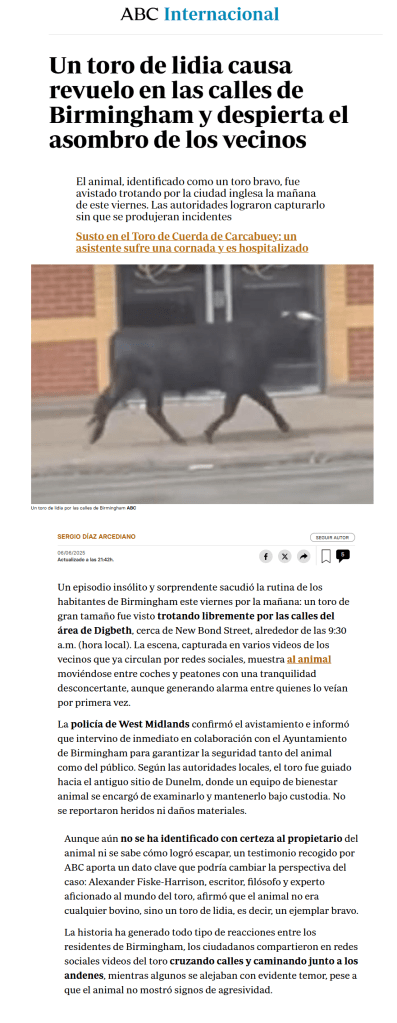
Spanish national newspaper ABC‘s article on the subject is translated beneath the screenshot below. 

Alexander Fiske-Harrison, author, philosopher, and expert aficionado of the world of the Spanish bullfight, stated that the animal was no ordinary bovine, but a toro de lidia, a fighting bull.

ABC
International

A Fighting Bull Causes a Stir in the Streets of Birmingham and Astonishes Locals
The animal, identified as a fighting bull, was spotted trotting through the English city on Friday morning. Authorities managed to capture it without incident.

An unusual and startling episode disrupted the routine of Birmingham’s residents on Friday morning: a large bull was seen trotting freely through the streets of the Digbeth area, near New Bond Street, around 9:30 a.m. (local time). The scene, captured in several videos shared by locals and now circulating on social media, shows the animal moving among cars and pedestrians with disconcerting calm—though naturally causing alarm among those seeing such a sight for the first time.

West Midlands Police confirmed the sighting and reported that they intervened immediately in coordination with Birmingham City Council to ensure the safety of both the animal and the public. According to local authorities, the bull was guided to the former Dunelm site, where an animal welfare team examined and took custody of it. No injuries or material damage were reported.

Though the owner of the animal has not yet been definitively identified, nor is it known how it managed to escape, a statement gathered by ABC provides a key detail that may shift the understanding of the event: Alexander Fiske-Harrison, writer, philosopher, and expert aficionado of the world of the Spanish bullfight, stated that the animal was no ordinary bovine, but a toro de lidia, a fighting bull.

The story has sparked all manner of reactions among Birmingham residents, who shared videos online of the bull crossing roads and walking along pavements, while some people retreated in evident fear, despite the animal showing no signs of aggression.

The Daily Mail, my niece & I

THE MAIL ON SUNDAY
April 6, 2025
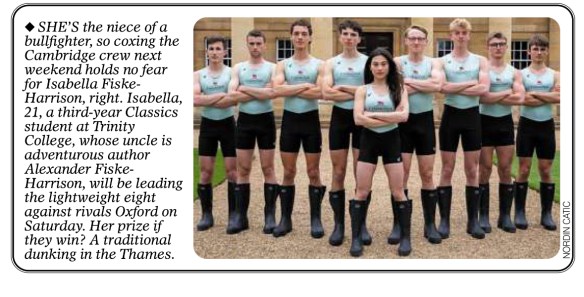
SHE’S the niece of a bullfighter, so coxing the Cambridge crew next weekend holds no fear for Isabella Fiske-Harrison, right. Isabella, 21, a third-year Classics student at Trinity College, whose uncle is adventurous author Alexander Fiske-Harrison, will be leading the lightweight eight against rivals Oxford on Saturday. Her prize if they win? A traditional dunking in the Thames.

All my recent forays into the press seem to involve me being written about rather than writing, and being written about as a side note to someone else’s life. At least in this case it is a blood relation, my niece – and goddaughter – Isabella, daughter of my eldest brother Byron, former cavalry officer in the British Army and director of Goldman Sachs and the reason I first took up playing polo. (Ironic that the journalist got in touch with me on the 37th anniversary of our dear late middle brother’s tragic death skiing, the brother by whom I was first introduced to Spain and bullfighting, Jules, about whom Giles Coren wrote so well here and later here – outside paywall – in The Times.)

Screenshot

Isabella was a Queen’s Scholar at Westminster School and is currenly a scholar at Trinity College, Cambridge studying Classics. She narrowly missed her blue for skiing, and now will take it instead for rowing.

Anyway, it is time I stopped riding on the coat tails of others, and the next project I am in print about here, the press, or anywhere else, will do exactly that.

Alexander Fiske-Harrison

Screenshot